By Aidan Nicholls September 27, 2026
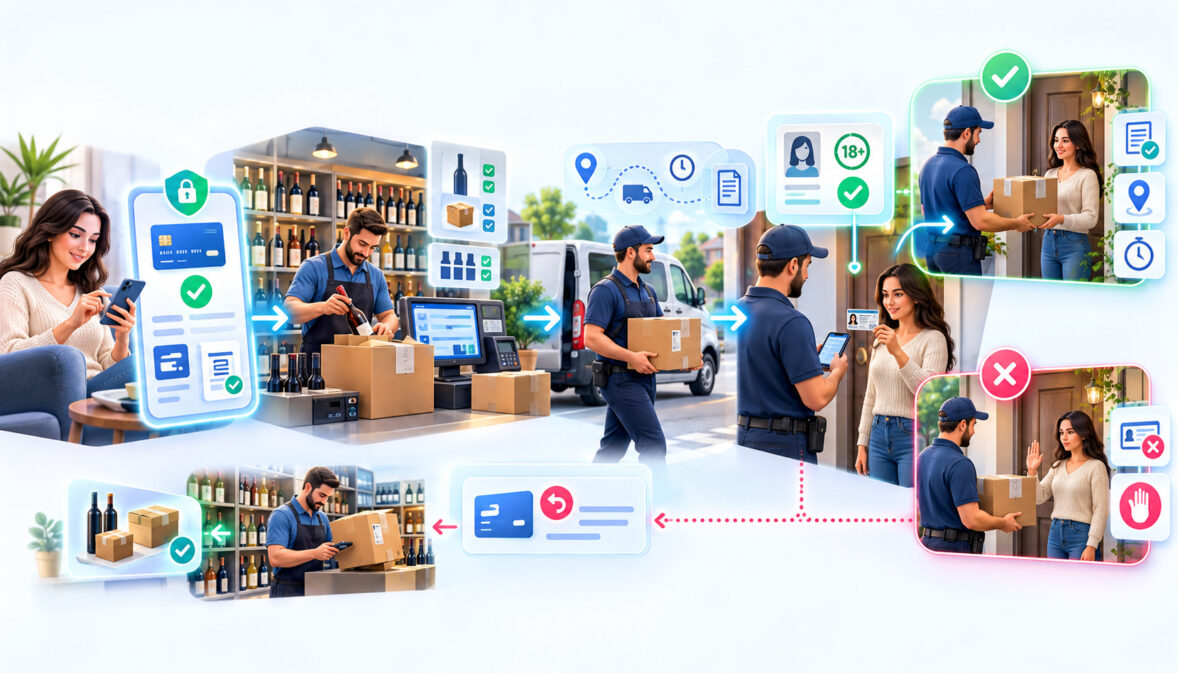
Alcohol delivery payment rules depend on the retailer’s exact license, state and local law, beverage type, delivery method, and who performs the delivery. Online prepayment does not replace required age or ID checks at handoff. Failed deliveries need documented custody, refund, and dispute procedures, and retailers should verify their specific alcohol authority before launch.
| Decision | Best Operational Question |
| Can we deliver? | Does our exact license authorize this delivery model? |
| Who can deliver? | Employee, authorized contractor, licensed third party, or marketplace? |
| When can we collect payment? | Before dispatch, at delivery, or either? |
| Who checks ID? | Who is legally responsible at the actual handoff? |
| What if delivery fails? | Who keeps custody and starts the refund workflow? |
| Who handles disputes? | Which entity is merchant of record for the card transaction? |
Alcohol delivery is not one nationwide retail privilege. A package store delivering manufacturer-sealed spirits, a grocery store delivering beer, a restaurant sending cocktails to-go, and an interstate winery shipment may all fall under different statutes and license privileges.
That distinction matters before anyone configures checkout.
Alcohol Delivery Payment Rules Start With the License
Payment configuration comes after licensing analysis, not before it. A checkout page cannot create delivery authority the retailer’s liquor license does not provide.
Before enabling liquor store delivery payments, identify the exact license class and determine whether it authorizes direct delivery, requires an endorsement, limits beverages, restricts delivery territory, or requires an authorized third party.
Because retail alcohol authority primarily sits at the state and local level, the first compliance step is identifying the regulator that controls the store’s license. TTB maintains an official directory of state alcohol beverage authorities, which retailers can use to locate the agency responsible for licensing, delivery privileges, and related state requirements.
TTB itself emphasizes that states regulate retail alcohol sales and that state and local requirements can differ substantially. Its directory of alcohol authorities is therefore a useful starting point for identifying the controlling regulator.
Verify at least:
- Retail license class
- Beverage categories covered
- Direct-delivery privileges
- Required delivery endorsement or permit
- Driver qualifications
- Employee versus contractor rules
- Delivery geography
- Local wet/dry restrictions
- Permitted delivery hours
- Recipient restrictions
- Required records
- Third-party delivery rules
- Payment-timing restrictions, if any
Do not use restaurant alcohol-to-go authority to justify package-store delivery. Likewise, intrastate home delivery should not be treated as equivalent to interstate shipment. TTB’s discussion of interstate alcohol shipment and state regulatory authority explains the continuing role of state law when alcoholic beverages move into another jurisdiction.
Which States Allow Retail Liquor Delivery?
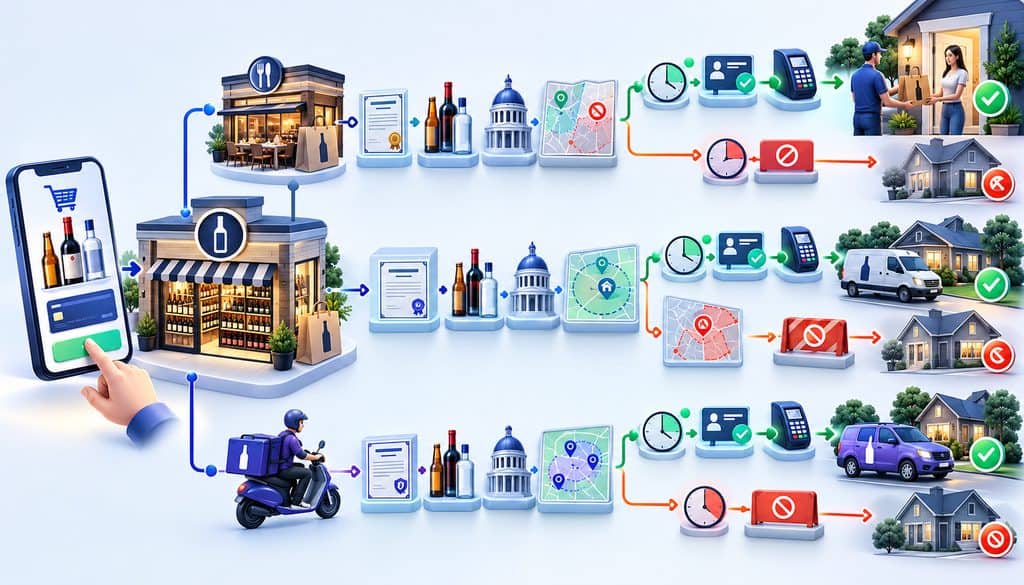
There is no responsible way to reduce current alcohol home delivery laws to a single nationwide “yes” or “no” count. Alcohol delivery payment rules can change with the license class, beverage type, retailer-versus-third-party delivery model, local geography, and conditions attached to the actual sale.
The following examples, verified September 26, 2026, show why a license-specific framework is more useful than a simplistic map.
| State | Retail Store Direct Delivery | Third-Party Delivery | Key Conditions | Payment Timing | Primary Source | Verified |
| Texas | Yes for specified retail permits | Yes through Consumer Delivery Permit holders | Permit class, beverage type, wet area and geography matter | TABC says authorized businesses may take orders/payment online or by phone | TABC | Sept. 26, 2026 |
| Florida | Vendors may deliver qualifying sales | Contracted third-party vehicles permitted | Electronic/phone/mail order can count as sale at licensed premises | Statute recognizes electronic orders | Fla. Stat. §561.57 | Sept. 26, 2026 |
| California | Depends heavily on license and product | Can involve agents/providers under licensee control | Do not confuse ordinary sealed-product privileges with expanded restaurant to-go rules | Transaction control remains important | California ABC | Sept. 26, 2026 |
| Virginia | Delivery exists under defined license privileges | Third-party delivery requires its own license | Recipient and delivery-person requirements apply | Depends on licensed model | Virginia ABC / Code | Sept. 26, 2026 |
Texas illustrates license-specific delivery particularly well. Package Store and Wine-Only Package Store permit holders may sell qualifying beverages for delivery and may self-deliver or use a Consumer Delivery Permit holder, while other permit classes have different rules and geographic limits. TABC also states that businesses authorized for alcohol-to-go may accept orders or payments online or by phone.
Florida takes another approach. Section 561.57 says vendors may make deliveries of sales made at the licensed business and expressly treats telephone, electronic, or mail orders received at the licensed premises as sales made there. Delivery may use vendor vehicles or qualifying contracted third parties.
California demonstrates why pandemic-era assumptions are dangerous. The current ABC materials say the temporary COVID regulatory relief expired in 2021, while separate permanent statutes now govern expanded to-go privileges.
California also distinguishes manufacturer-sealed products from certain restaurant-prepared drinks that may be picked up but not delivered under the expanded to-go statute.
Virginia illustrates a separate regulated third-party model. Its current statute requires third-party delivery licensees when applicable and imposes training and qualification requirements on delivery personnel.
Retailer-direct delivery
Determine whether the retailer’s license itself permits the employee or agent to leave the premises with alcohol for consumer delivery.
Third-party or marketplace delivery
Determine whether the third party needs a separate alcohol-delivery license or must operate solely as the retailer’s agent.
Conditional or license-specific delivery
Beer, wine, spirits, cocktails, restaurant orders, package-store orders, and manufacturer shipments may receive different treatment.
Restricted jurisdictions or local exceptions
Even statewide authorization may not override dry areas, municipal rules, licensed-territory restrictions, prohibited delivery destinations, or product-specific limitations.
Prepay Online vs Pay at the Door
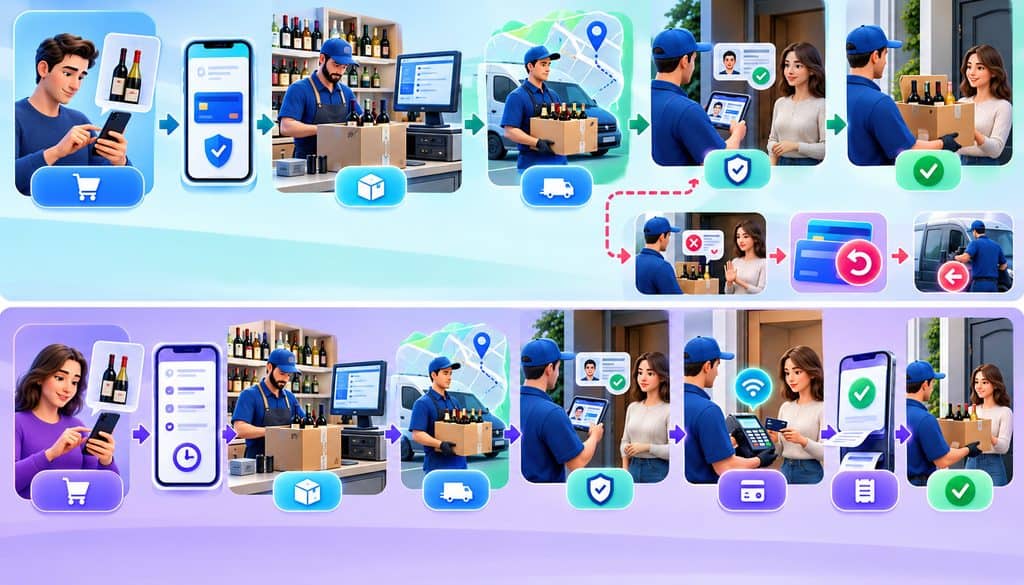
Prepaying is operationally attractive because the store knows the order has a valid payment authorization before it allocates inventory and dispatches a driver. But alcohol delivery payment rules may determine whether payment can be collected before dispatch, at the door, or through either method, so the store must verify its jurisdiction and license before configuring checkout.
| Issue | Prepay Online | Pay on Delivery |
| Card environment | Usually card-not-present | Card-present/mobile or CNP |
| Dispatch certainty | Higher | Lower |
| Driver payment handling | Minimal | Greater |
| Failed delivery | Void/refund workflow needed | Sale may never be captured |
| Tips | Checkout or permitted post-delivery adjustment | Usually entered at handoff |
| State compatibility | Verify jurisdiction | Verify jurisdiction |
| Dispute evidence | Payment record + delivery evidence | Payment + handoff evidence |
| ID verification | Still required where applicable | Still required where applicable |
Prepay plus doorstep verification is operationally common because it separates payment from physical eligibility. It should not be described as a nationwide legal requirement.
A prepaid delivery order usually enters the payment system differently from an in-store transaction, so retailers should keep contactless and mobile payments used at the physical liquor-store checkout operationally separate from card-not-present alcohol payments, where fraud screening, delivery evidence, refund handling, and recipient verification become more important.
Prepayment Does Not Mean the Alcohol Has Been Delivered
A successful authorization proves that a payment credential received issuer approval. It does not establish that alcohol was lawfully handed to an eligible recipient.
Keep these events separate in the POS:
- Customer places order.
- Checkout validates the delivery zone.
- Customer completes any required age affirmation.
- Payment is authorized or collected under applicable rules.
- Inventory is allocated.
- Order is prepared.
- Authorized delivery personnel take custody.
- Recipient eligibility is checked at the destination.
- Alcohol is delivered or refused.
- POS records final disposition.
- Refund, void, or adjustment begins if necessary.
This architecture becomes especially valuable during disputes. “Payment approved” and “delivery completed” should be two independently auditable events.
ID Verification Alcohol Delivery: What Happens at the Door?
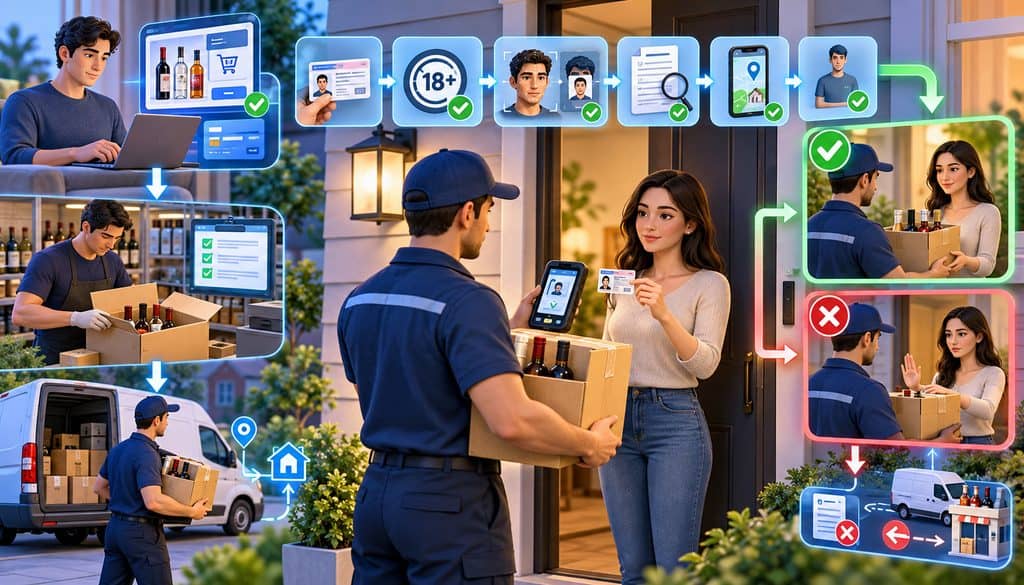
Virginia provides a concrete example of why doorstep verification must be configured by jurisdiction: under its third-party alcohol-delivery statute, the delivery provider must verify that the recipient is at least 21, review qualifying identification, reasonably match the photograph to the recipient, and record specified delivery information.
Effective liquor delivery age verification therefore needs a separate doorstep control that reflects the requirements of the retailer’s state, license type, delivery model, and recipient rules.
The delivery person should follow the specific standard imposed by the state, license type, employer, and delivery arrangement.
Physical ID inspection
Alcohol delivery ID requirements should be configured from the applicable jurisdiction rather than assumed nationally. Where identification is required, the driver needs to inspect the type of evidence permitted by that jurisdiction, so the delivery app should not impose a driver’s-license-only rule unless the relevant law supports it.
Virginia’s consumer-facing ABC delivery program, for example, requires a valid ID for every delivery and permits another person age 21 or older to accept an order even when that person did not place and pay for it, provided the program’s delivery conditions are satisfied.
That illustrates an important point: payer, purchaser, cardholder, recipient, and person whose ID was checked are not necessarily the same role.
ID scanning
Scanning can help read document data, calculate age, flag expiration, or assist fraud controls. It does not by itself establish that:
- The document belongs to the person presenting it
- The document is genuine
- The recipient is legally eligible
- The recipient may lawfully receive alcohol at that destination
- The individual satisfies any intoxication-related restriction
Use scanning as a tool, not as an automatic substitute for the required human or legally prescribed verification process.
Match the person to the ID
The driver age verification workflow should therefore record the result of the eligibility check separately from payment approval, order status, and the identity of the original purchaser.
Virginia’s third-party delivery law specifically requires age verification at delivery and requires the identification photograph to reasonably appear to match the recipient.
Payer versus recipient
Do not hard-code “cardholder must answer the door” unless law or retailer policy requires it.
Instead, record distinct fields for the purchaser, payment account, delivery recipient, and verification result where needed. That separation also improves fraud investigations and chargeback responses.
Intoxication or another prohibited recipient
Use the terminology of the state involved. California, for example, prohibits furnishing alcohol to an “obviously intoxicated person,” while Virginia’s delivery statute addresses a person whom the delivery licensee knows or has reason to believe is intoxicated.
Do not translate these state-specific standards into a fictional nationwide “sober-recipient rule.”
Driver refusal workflow
When delivery cannot lawfully be completed:
- Do not transfer the alcohol.
- Keep the product under authorized custody.
- Select the correct refusal reason.
- Record the arrival time and location.
- Record the verification result using only necessary data.
- Return the product under the required procedure.
- Trigger refund or adjustment review.
- Reconcile product custody before closing the order.
Expert Insight: [Insert a short quote from a state alcohol-compliance attorney, licensing specialist, or retailer compliance officer about aligning the payment flow with the licensed delivery model.]
What Should the Driver Record?
Capture enough information to prove operational events without turning the driver app into an unnecessary identity database.
| Evidence | Operational Purpose | Chargeback Value | Privacy Caution |
| Order number | Connects handoff to POS | High | Low |
| Address | Confirms destination | High | Limit access |
| Arrival timestamp | Establishes event timing | Useful | Low |
| GPS event | Supports presence at location | Supporting only | Geolocation is sensitive |
| Driver ID | Accountability | Supporting | Internal access |
| Recipient name | Identifies recipient | Useful where permitted | Retain only if needed |
| Verification result | Compliance record | Supporting | Avoid excess ID data |
| ID type | Audit support | Limited/supporting | Do not store full document |
| Signature | Handoff evidence | Often useful | Secure retention |
| Refusal reason | Failed-delivery audit | High for refund dispute | Avoid subjective notes |
| Return time | Inventory custody | Useful | Low |
Avoid collecting full ID images, complete ID numbers, full barcode payloads, full dates of birth, or facial imagery merely because the scanner makes it easy.
Data minimization should apply to payment data too. PCI DSS requires organizations to limit retained cardholder data to what is necessary, and card-verification codes such as CVV cannot be stored after authorization.
Refused and Failed Alcohol Deliveries
A failed alcohol delivery is an inventory-custody event, a customer-service event, and potentially a payment event at the same time.
| Failure Reason | Product Custody | Customer Charge | Refund/Adjustment | Evidence |
| Nobody present | Driver retains alcohol | Apply disclosed policy | Void/refund review | Time, GPS, attempt |
| No acceptable ID | No handoff | Policy + law govern | Refund review | Verification failure |
| Underage recipient | No handoff | Policy + law govern | Refund review | Refusal reason |
| Prohibited intoxication condition | No handoff | Policy + law govern | Refund review | Driver record |
| Customer refuses | Driver retains alcohol | Depends on circumstances | Review items/fees | Refusal record |
| Wrong item | Recover/replace | Correct transaction | Partial/full refund | SKU/order evidence |
| Damaged item | Do not transfer if unusable | Adjust | Refund/replacement | Photo if appropriate |
| Address inaccessible | Retain alcohol | Policy governs | Review | Attempt record |
| Delivery becomes unlawful | Return merchandise | Do not complete transfer | Appropriate adjustment | Compliance reason |
Virginia expressly requires alcoholic beverages that cannot lawfully be delivered under its third-party regime to be promptly returned to the licensed establishment where they were purchased.
Do not invent a universal restocking charge. Whether a delivery fee, service fee, or other amount can be retained depends on applicable law and what the customer was clearly told before purchase.
Prepaid Alcohol Order Refunds
A retailer evaluating prepaid alcohol order refunds must answer three separate questions:
- What does alcohol law require?
- What does applicable consumer/refund law require?
- What did the retailer disclose before the customer paid?
The payment system should separately support authorization reversal, void, captured-payment refund, partial refund, delivery-fee adjustment, substitution adjustment, and tip correction where appropriate.
An authorization reversal tells the payment chain that an approved authorization will not be completed. A refund is different: the original transaction has already been captured and a credit is being sent back through the payment system.
Customer bank posting time is another issue altogether and should not be advertised as though the merchant controls the issuer’s posting speed.
A retailer should also avoid quietly retaining the full purchase price for merchandise that was never lawfully transferred unless there is a valid legal and contractual basis.
Virginia ABC provides a useful operational example: its state-store program says an ID failure causes the order to be returned and refunded, while its published program terms retain the delivery fee and tip. That is an example of one disclosed program—not a nationwide rule for private retailers.
Failed Delivery Chargeback Alcohol: Building a Defensible Record
A failed delivery chargeback must be answered according to the actual dispute category.
Common allegations include:
- Merchandise not received
- Unauthorized transaction
- Merchandise not as described
- Credit not processed
- Duplicate processing
The evidence package should therefore answer that allegation rather than simply prove that an order existed.
For a completed delivery, useful material can include the order confirmation, payment record, delivery address, timestamp, GPS event, recipient-verification record, signature where collected, customer communications, and other proof of delivery.
Visa’s merchant guidance describes compelling evidence as information that may establish participation in a transaction or receipt of goods or services, but Visa expressly cautions that such evidence does not force a particular dispute outcome.
Mastercard’s January 2026 merchant chargeback guide likewise recognizes merchant documentation showing that the cardholder or an authorized person received merchandise. Examples include delivery documentation, signed pickup receipts, or signed proof of delivery, depending on the dispute.
GPS by itself does not prove who received the alcohol. A signature does not guarantee representment success. An ID check does not automatically rebut an unauthorized-payment dispute.
When delivery disputes begin arriving, a documented chargeback-management process for liquor-store transactions helps staff connect the disputed payment with the original order, verification record, delivery status, customer communications, and any refund already issued.
Your Own Drivers vs Marketplace Delivery Apps
Do not assume a marketplace automatically becomes merchant of record or assumes alcohol-law responsibility.
| Question | Retailer’s Own Drivers | Marketplace / Third Party |
| Who accepts order? | Usually retailer | Contract-specific |
| Seller/licensee | Retailer | Must be identified |
| Merchant of record | Usually retailer account | Contract-specific |
| Payment capture | Retailer processor | Platform structure varies |
| ID verification | Retailer staff | Contract/licensing governs |
| Delivery evidence | Retailer systems | Platform may hold data |
| Refund | Retailer | Contract-specific |
| Chargeback | Merchant of record | Contract-specific |
| Driver training | Retailer | Platform/provider |
| Delivery liability | Retailer-controlled | Allocation varies |
Before launch, put the answers in writing for:
- Merchant of record
- Seller of record
- Alcohol license being relied on
- Payment processor
- Settlement recipient
- Refund owner
- Chargeback owner
- ID-verification party
- Customer-support party
- Tax responsibility
- Driver responsibility
- Evidence-retention responsibility
California is especially instructive. Its ABC guidance has emphasized that alcohol sales involving third-party providers remain under licensee control and that unlicensed providers cannot simply become independent alcohol sellers by inserting themselves into the transaction.
Merchant of Record: Who Actually Eats the Dispute?
Merchant of record is a payments and commercial concept. It is not automatically the same thing as the alcohol licensee.
Operationally, identify:
- Whose descriptor appears on the statement
- Which entity submits the card transaction
- Which merchant account receives settlement
- Who receives the acquirer’s dispute notice
- Who owes a refund
- What indemnification exists between retailer and platform
If the retailer is merchant of record, a marketplace driver performing the physical delivery does not automatically transfer the card dispute to the marketplace.
Likewise, making a technology platform merchant of record does not by itself give that entity alcohol-license privileges.
Three-Tier Delivery Compliance
Delivery technology should preserve the legal structure of the sale rather than quietly redesign it.
A platform can create three-tier problems if it changes who controls alcohol pricing, who owns the product, who receives the alcohol-sale proceeds, or whether an unlicensed intermediary exercises functions reserved to the licensee.
California ABC’s third-party-provider guidance illustrates this principle: the licensed seller must ultimately control the transaction, including acceptance and fulfillment, and arrangements involving collected funds must preserve licensee control.
The precise rule is jurisdiction-specific. Do not transplant California’s third-party-provider framework into Texas, Florida, or another state without checking that state’s law.
POS and E-Commerce Configuration
The online liquor store checkout should enforce the licensed operating model automatically.
Age-gated checkout
Use age affirmation or permitted online verification as an early screening control, while keeping doorstep verification as a separate event wherever required.
An online age affirmation should remain separate from the final handoff control, while the POS can still use age-restricted payment and ID-verification controls to flag alcohol transactions and require the appropriate verification step before the sale is completed.
Delivery-zone rules
Rules may need to account for:
- State
- ZIP code
- City and county
- Wet/dry areas
- Licensed territory
- Prohibited destinations
- Service radius
- Driver availability
Product rules
Do not treat beer, wine, and spirits as interchangeable if state law does not.
Delivery time controls
Block checkout slots or dispatches that would result in delivery outside lawful hours.
Payment logic
Support authorization, capture, void, partial capture, refund, partial refund, and permitted tip adjustment as distinct events.
Order statuses
Useful states include:
Payment authorized → Accepted → Picking → Ready → Driver assigned → Out for delivery → ID verified → Delivered
Failure branches should support:
Refused → Returned → Refund pending → Refund completed
Reconciliation
Connect the POS order with the payment transaction, driver manifest, delivery result, returned inventory, tip, delivery fee, refund, and processor settlement.
End-of-Shift Driver Reconciliation
Every alcohol unit assigned for delivery should finish the shift in one of two places: documented as lawfully delivered or physically reconciled back into authorized custody.
- Reconcile every assigned order.
- Confirm delivered versus returned status.
- Investigate unresolved deliveries.
- Match captures to completed sales under the configured payment policy.
- Review voids, reversals, and refunds.
- Reconcile tips.
- Reconcile delivery fees.
- Return failed-delivery inventory to the proper stock location.
- Confirm required delivery evidence uploaded successfully.
- Escalate discrepancies before closing the shift.
This prevents a failed ID check from becoming an unexplained inventory shortage and a customer charge at the same time.
Example Delivery Scenarios
Example 1: Successful prepaid delivery
A customer orders sealed products online and pays at checkout. The POS verifies the delivery zone and assigns the order to an authorized driver.
At the door, the driver completes the jurisdiction’s required recipient verification, records the permitted delivery evidence, transfers the alcohol, and closes the order as delivered.
Example 2: Customer cannot produce acceptable ID
The customer has already paid, but the driver cannot complete the required verification.
No handoff occurs. The driver records the reason, retains custody, returns the alcohol to the store, and the retailer applies its legally reviewed and previously disclosed refund policy.
Example 3: Customer disputes a completed delivery
The cardholder later claims the merchandise was not received.
The retailer retrieves the order record, payment transaction, delivery address, timestamp, GPS event, permitted recipient-verification evidence, signature or other proof of delivery, and relevant communications.
The representment package should answer the actual dispute claim—not simply state that the store believes the driver completed the order.
Common Mistakes
| Mistake | Why It Creates Risk | Better Control |
| Online age checkbox treated as final verification | No doorstep eligibility control | Separate checkout and handoff checks |
| One state’s rules copied nationwide | License privileges differ | Jurisdiction rules engine |
| Restaurant rules used for package stores | Wrong license authority | Map rule to license class |
| Alcohol left unattended | Recipient cannot be verified | Require completed handoff |
| Refusals undocumented | Weak refund/dispute record | Standard reason codes |
| Full ID data retained unnecessarily | Privacy/security exposure | Data minimization |
| No failed-delivery workflow | Refund and inventory errors | Automated failure branch |
| Marketplace assumed to own disputes | Contract may say otherwise | Define merchant of record |
| Returned bottles not reconciled | Inventory mismatch | End-of-shift custody audit |
| Card approval treated as delivery proof | Payment ≠ handoff | Separate statuses |
| Pandemic rule still used | Authority may have expired | Verify permanent law |
| Generic ZIP delivery radius | May ignore local restrictions | Compliance-aware zones |
Alcohol Delivery Launch Checklist
Licensing
- Confirm exact license class.
- Confirm beverage types.
- Confirm delivery authority.
- Check third-party licensing.
- Check local restrictions and dry areas.
- Confirm driver qualifications.
Payments
- Confirm processor/acquirer approves alcohol delivery.
- Determine prepay versus pay-on-delivery rules.
- Configure authorizations, voids, and refunds.
- Establish recognizable card descriptor.
E-commerce
- Validate delivery destination before acceptance.
- Configure product-specific rules.
- Block prohibited delivery windows.
Driver procedures
- Create handoff and refusal scripts.
- Define custody rules.
- Train drivers on prohibited recipients.
ID verification
- Identify acceptable evidence under applicable law.
- Define visual matching procedure.
- Define scanner use separately from data retention.
Refunds
- Publish failed-delivery terms before purchase.
- Define delivery-fee and tip treatment.
- Distinguish voids from captured-payment refunds.
Chargebacks
- Preserve order and payment records.
- Retain lawful proof-of-delivery evidence.
- Respond according to dispute category.
Marketplace contracts
- Identify seller and merchant of record.
- Allocate refunds and chargebacks.
- Define responsibility for driver training and ID checks.
Data privacy
- Minimize ID information.
- Secure location and signature data.
- Do not retain CVV after authorization.
Reconciliation
- Match orders, payments, deliveries, returns, refunds, inventory, and settlement every shift.
Frequently Asked Questions
Can a liquor store take payment online before checking ID?
Sometimes. Texas, for example, expressly permits authorized businesses to take alcohol-to-go orders or payments online or by phone. But the retailer must verify that its own state, license class, and delivery model permit the payment flow.
Does the credit-card holder have to receive the alcohol?
Not necessarily. State law, retailer policy, fraud controls, and delivery terms are separate questions. Virginia ABC’s delivery program, for example, allows another qualifying adult recipient under its stated conditions.
Can a driver scan a customer’s ID?
Potentially, but legality and retention requirements need separate review. Scanning should not be confused with the complete eligibility decision, and unnecessary ID data should not be retained.
Can alcohol be left at the door?
Do not assume so. Where the applicable law or delivery program requires verification of the recipient’s age or identity at handoff, unattended delivery is incompatible with that procedure.
Can we keep the delivery fee when the customer has no valid ID?
Possibly, but not as a universal rule. Applicable alcohol/consumer law and the retailer’s pre-purchase disclosures must support the policy.
Should we refund a refused alcohol delivery?
Review what merchandise was actually transferred, why delivery failed, applicable law, and the published refund policy. Do not automatically treat an undelivered alcohol purchase as a completed delivery.
What evidence helps fight an alcohol delivery chargeback?
Order confirmation, transaction records, delivery address, timestamps, GPS data, appropriate recipient verification, signature or other proof of delivery, refund records, and communications may help. The best evidence depends on the dispute reason.
Is DoorDash, Uber, Instacart, or another marketplace always merchant of record?
No. Review the actual payment and commercial agreement. Marketplace participation alone does not establish merchant-of-record status.
Can we use our regular website gateway for delivery?
Only if the gateway, acquirer, and merchant-account underwriting support the alcohol-delivery business model. A processor approved only for ordinary in-store retail should not automatically be assumed to cover a materially different online delivery channel.
Before adding delivery to an existing account, confirm that the processor’s underwriting profile actually covers the new sales channel, because merchant-account underwriting for alcohol retailers may need to account for online ordering, card-not-present exposure, delivery geography, expected ticket size, and the retailer’s compliance controls.
Does online age verification replace ID checking at delivery?
Not automatically. Online verification and legal eligibility at the physical handoff are separate controls unless the governing law expressly establishes another approved process.
Build the Delivery Workflow Around the License, the Handoff, and the Payment Record
Effective alcohol delivery payment rules start with three controls: verify that the exact license and jurisdiction authorize the proposed delivery model; keep doorstep eligibility verification separate from online payment; and establish failed-delivery, product-custody, refund, and chargeback procedures before the first driver leaves the store.
The strongest delivery system can reconstruct the entire order—from checkout and payment authorization to driver custody, recipient verification, final handoff or refusal, inventory return, refund, and processor settlement.
That record protects compliance operations and payment operations at the same time.